
Tycho Brahe on John Dee
Stella nova, New Star of 1572

“Johannes Dee, Englishman.
After this little book of Digges, a brief treatise indeed by the most excellent and most famous man Dr. John Dee of London, published in print, there follows that which he calls the “nucleus” of Parallactic commentary and practice. He is indeed learned and highly ingenious, and not a little useful in unfolding and distinguishing the differences of parallax.
However, since this new star, which we chiefly discuss here, contains no observations nor practical applications drawn according to this nucleus, but only promises in the preface that he will carry out such work in the future (which, however, whether he has yet fulfilled I do not know), I do not think it worthwhile to add anything further to the theorem of the Parallactic nucleus itself, since it is sufficiently and in every respect fortified and explained by geometrical demonstrations competently provided by the author.
It would be desirable that, if that most distinguished Dee obtained any precise observations on this star, they should have been made public. Nor indeed do I doubt that he, as a man endowed with a keen intellect and remarkable diligence and philosophical subtlety, carefully observed the appearances of this star with solid application.
The distinguished mathematician of the most illustrious Prince William of Hesse, Christoph Rothmann, reported to me that when he, by command of my Prince, visited me for the purpose of examining my astronomical instruments, he had recently learned from familiar conversation with Dr. John Dee that Dee, when passing through Kassel on his return to his homeland, held the opinion that this new star was indeed contained within the vast capacity of the ethereal world, yet was not fixed in one and the same place with respect to its distance from the Earth, but had gradually risen from a lower position to a higher one along a straight line.
This opinion, although it seemed not unacceptable to the said illustrious Prince and also to Cornelius Gemma, nevertheless—both at that time and in Dee’s own judgment (so I would say)—was in no way consistent with this star. For, besides the fact that such an ascent and descent in a straight line, that is, an imperfect motion, cannot rightly be attributed to celestial bodies, which are accustomed only to circular and perfectly regular motion, it follows also that if at any time this star was lower or had any parallax, then either it had none at all, or if it had any, it ought to be demonstrated by certain and indisputable observations that it gradually diminished. But if it had none, then its ascent through lack of parallax could not be proven, for it would lie beyond all senses and exclude all means of demonstration.
And since knowledge arises from the senses, when these fail, hardly anything can be admitted in natural philosophy unless one wishes to accept conjectures as scientific certainty. But that no parallax was ever present in this phenomenon, as we have sufficiently demonstrated in many ways and beyond all doubt, and if anything has been asserted differently by others, it must have arisen from errors of instruments or observation.
Therefore it does not seem at all probable that this star receded from the Earth along a straight line; even the very nature of the heavens, as we have said, opposes this. When I also examined the views of Cornelius Gemma on this matter, I discussed it at length. And if nothing else demonstrated that the matter is not so, the absurd consequence alone would suffice: namely that this star would have had to be removed more than 300,000 semidiameters of the Earth before it attained the same magnitude which it appeared to have when placed just above Saturn, while retaining its brightness, and that by simple optical distance from the eye it would appear like a star of the sixth magnitude.
This would imply a distance more than twenty times greater than that from the Earth to its initial position in its supposed ascent, thus making the celestial region above Saturn greater by an incredible extent.
For who would willingly admit such an excessive magnitude of the world as a firm conclusion? And what would happen if the star were carried even higher, until it entirely escaped human sight (to which even sixth-magnitude stars are still visible)? I do not see how those who attempt to explain its apparent diminution by saying it receded farther from our view can escape this absurdity, unless they claim it was gradually diminished in itself by a single ascent. But this is easier to assert than to prove.
And if it is granted that, contrary to the natural motion of the heavens, which is perpetually circular, it was not bound to the usual motions of celestial bodies, then why should it not also be admitted that it remained always in the same place, and rather than ascending higher, was gradually dissolved?
But if anyone further insists that this star, arising outside the natural order, was not subject to the customary motions of celestial bodies, certainly no one, by sound reasoning, will be persuaded to believe that it, being subject to universal revolution and like the fixed stars always remaining in one place, nevertheless violated the laws of the fixed stars.
But now I will bring this examination of English observations to an end, since in Scotland and the northern part of this most extensive and flourishing island of Britain nothing, as far as I know, has yet been published about this remarkable star, although mathematicians of sharp intelligence are not lacking. Therefore, leaving aside all of Britain, I will turn myself toward the nearer Germans, among whom some, besides those already mentioned, have also written about this star; and from them I will try to investigate further what remains to be learned.” - Tycho Brahe1
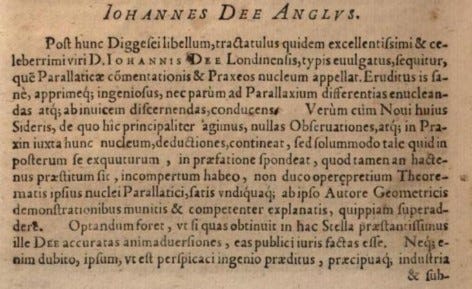
Ioannes Dee Anglus
Post hunc Diggesii libellum, tradatulus quidem excellentissimi & celeberrimi viri D. Ioannis Dee Londinensis typis evulgatus, sequitur quod Parallacticae commentationis & praxeos nucleum appellat. Eruditus is sane, apprimeque ingeniosus, nec parum ad Parallacticas differentias enucleandas atque ab invicem discernendas conducens.
Verum cum haec nova Stella, de qua hic principaliter agimus, nullas observationes atque in praxin iuxta hunc nucleum deductiones contineat, sed solummodo tale quid in posterum se executurum in praefatione spondeat (quod tamen an hactenus praestitum sit incompertum habeo), non duco operae pretium theorema ipsum nuclei Parallactici, satis undique ab ipso auctore geometricis demonstrationibus munitum et competenter explanatum, quippiam superaddere. Optandum foret ut, si quas obtinuit in hac stella praeclarissimus ille Dee accuratas animadversiones, eas publici iuris factas esse.
Neque enim dubito ipsum, ut est perspicaci ingenio praeditus ac praecipua industria et subtilitate philosophica, solidā quoque diligentia huius sideris apparitiones observasse.
Retulit mihi eximius illustrissimi Principis Guilielmi Hassiae mathematicus Christophorus Rothmannus, cum me, iussu mei Principis, instrumentorum meorum astronomicorum perspiciendorum causa non ita dudum invisisset, quod ex familiari colloquio praedicti D. Ioannis Dee intellexerat, cum Cassellas, redeundo in patriam, transiret, ipsum omnino in ea fuisse sententia stellam hanc neotericam intra quidem mundi aetherei vastissimam capacitatem contentam extitisse, attamen non in eodem loco quo ad remotionem a Terra perpetuo permanere, sed paulatim ab humiliore situ in sublimiorem per lineam rectam ascendendo se recepisse.
Quae sane opinio, etsi ab illustrissimo principe ac etiam a Cornelio Gemma non improbanda visa est, tamen tum horum tum ipsius Dee iudicio nullo modo huic stellae consentanea fuit. Praeterquam enim quod talis per rectam lineam ascensus atque descensus, motus imperfectus, caelestibus corporibus, quae circulari tantummodo gyrationi et eidem absolutae ac regulari perpetuo assueverunt, attribui non possit, accedit etiam quod, si aliquando humilior fuit haec stella aut aliquam habuit parallaxin aut nullam: si aliquam, ea certis rationibus demonstranda fuisset; quodque paulatim se attenuasset ostendendum; sin vero nullam habuit, certe eius ascensus per parallaxin carentiam probari non poterat, esset enim extra omnes sensus et demonstrationis vias universas praecluderet.
Cumque ex sensibus cognitio procedat, his deficientibus in physicis vix ulla concedi poterit, nisi quis coniecturas pro certa scientia recipere velit. Verum cum nulla prorsus huic phaenomeno unquam adfuerit parallax, quemadmodum satis a nobis demonstratum est, et si quid ab aliis aliter prolatum, id vitio instrumentorum atque collationis evenisse necesse habeat, stellam hanc per lineam rectam se a Terra elongasse nequaquam probabile evadit, naturae etiam caelestium id ipsum adversante.
De quo etiam cum Cornelii Gemmae placita excuterem, nonnulla egimus. Et si nihil aliud esset quod rem hanc non ita se habere directe convinceret, certe absurdum illud quod sequitur sufficeret: oportuisse hanc stellam ultra 300000 semidiametrorum Terrae removeri, antequam eandem magnitudinem quam proxime supra Saturnum constituta obtinuit retineret, per solam elongationem ab oculo instar stellulae sextae magnitudinis apparens.
Id ipsum tantam inducit rationem ut plus quam vicies illud spatium quod erat a Terra ad primum eius situm in suo ascensu superasse debuisset, sicque vastitatem caeli supra Saturnum incredibili ratione maiorem reddere.
Quis autem hanc nimiam mundi magnitudinem sibi facile concedere velit? Et quid fieret si adhuc altius attolleretur, donec prorsus omnem oculorum sensum effugeret (cui stellae sextae magnitudinis adhuc subiciuntur)?
Sane non video quomodo ex hac absurditate se extricent qui stellam hanc imminutionem per altiorem ab intuitu nostro recessum excusare conantur, nisi forte dicere velint eam paulatim in se ipsa fuisse diminutam per solum ascensum. Quod facilius asseritur quam probatur.
Et si id concedatur, cur non etiam admitti possit eam in eodem semper loco permanentem, ac potius non altius ascendentem sed paulatim dissolutam fuisse?
Quod si quis ulterius praetenderit hanc stellam, praeter naturalem ordinem ortam, motibus caelestium corporum non fuisse alligatam, certe cum revolutioni universali obtemperarit et instar fixarum in uno loco semper permanserit, aliud quid praeter leges fixarum admisisse nemo iustis rationibus persuadebit.
Sed nunc Anglicanae huius contemplationis disquisitioni finem imponam, cum in Scotia et reliqua huius amplissimae et florentissimae insulae Britanniae parte boreali nihil, quod sciam, de hac peregrina stella in lucem ediderint, licet mathematici perspicaci ingenio praediti non desint. Relicta itaque tota Britannia ad nobis viciniores Germanos me conferam, apud quos quidam, praeter superiores enumeratos, de hac stella commentati sunt; unde ulterius quid verum sit investigare conabor.
https://archive.org/details/bub_gb_CVOItHLenPEC/page/n780/mode/1up
This is what the world needs
Interesting that John Dee thought this new star heralded the New Jerusalem...